
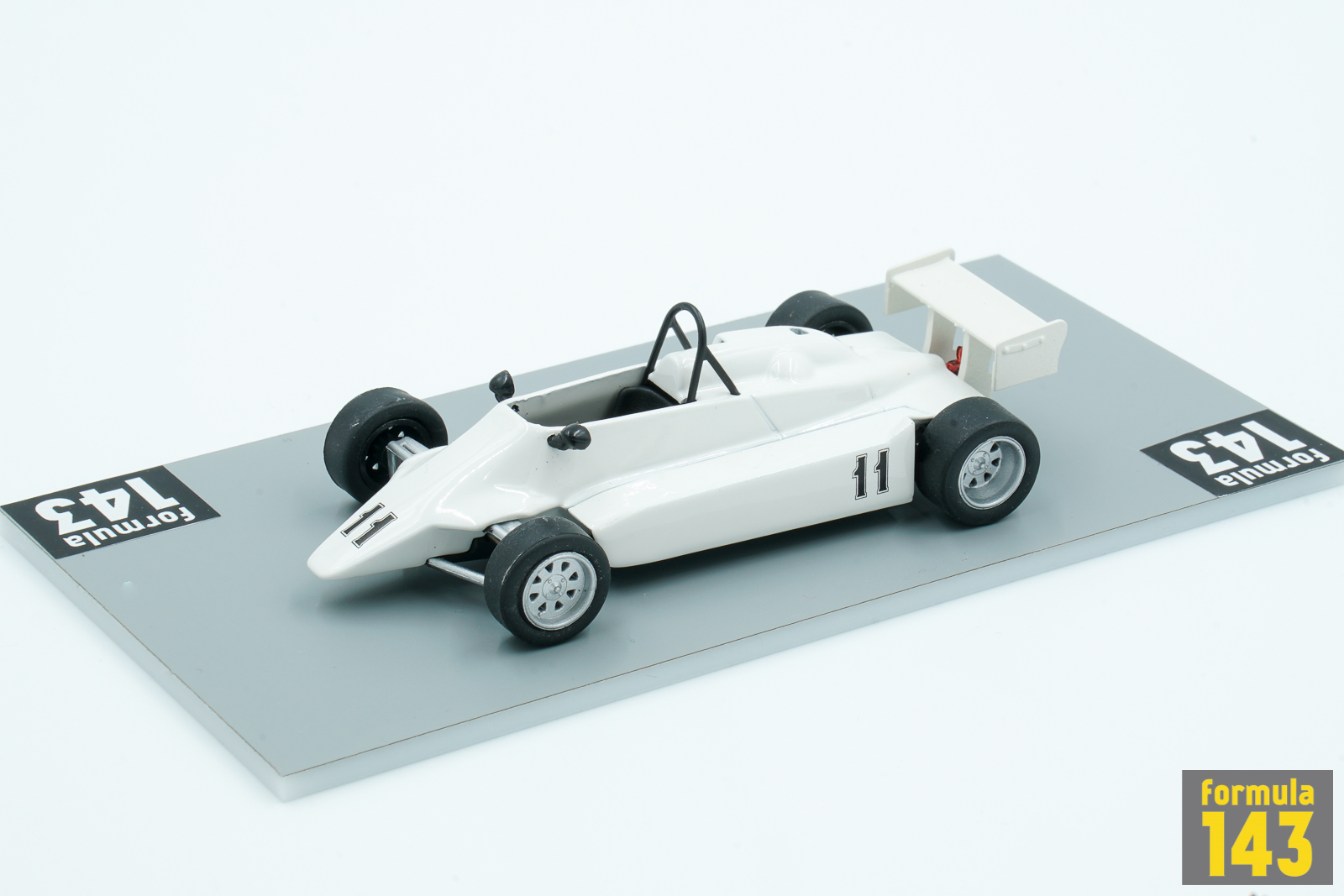


Tallinn Experimental Automotive Repair Plant (TOARZ or TARK in Estonian) in the Estonian SSR produced racing cars for formulae 3, 4, Junior and Easter (Vostok) from 1958 to the early 1990s. TARK cars were designed and manufactured under the brand name Estonia. The most successful and progressive TARK racing car definitely was Estonia 21, which appeared in 1980. Estonia 21 won the Friendship Cup of Socialist Countries four times in a row (1987-1990), proving itself to be one of the most successful single-seater models in the Eastern Bloc and, definitely, the best racing car ever made in the USSR.
Estonia 21 designed by racing engineer and driver Raul Sarap, was a real breakthrough in USSR motorsport. The Estonia was the first to use ground effect to improve aerodynamics and was created with an eye on the Lotus 81. TARK engineers admitted that at that time they considered the Lotus team to be the trendsetter in the world of formula racing. Estonia 21 bodywork was a spatial frame made of 32 mm diameter pipes with an additional frame made of 22 mm pipes at the rear, on which the engine and transmission were mounted. The fiberglass body panels were glued by hand and had. The brakes on all wheels were disc brakes, located at the rear near the main gear. The elastic elements of the front wheel suspension were located inside the nose cone, and the rear ones were positioned near the main gear. In the side pontoons behind the radiators, there were profiles in the form of an inverted wing, when air flowed under them, a vacuum was created, pressing the car to the road. The sides had seals at the bottom in the form of elastic curtains.
The Estonia 21 was produced from 1980 to 1991 – a total of 295 cars of all modifications were built. A VAZ -2101 engine with a volume of 1300 or 1600 cm³ was used, with a five-speed gearbox. Depending on the engine capacity, Estonia cars were suitable for Formula 3, Formula Easter (Formula Vostok) and, later, Formula Mondial.
After the original 21 model, the Estonia-21M (1985-1987) appeared – a modification of the Estonia-21, lightened to 420 kg, with a frame almost five times more rigid, with a modified layout of units and assemblies, reduced brake weight and other innovations. Toomas Napa won the Friendship Cup of Socialist Countries driving the 21M in 1987.
Estonia-21.10 appeared in 1986 and was the final modification of the Estonia 21, additionally lightened by 11 kg compared to the 21M, with multiple changes to the frame, suspension, and brake system. It had two versions: one for sale to sports clubs and sections, and a version for the USSR national team, with a body lightened by 10 kg and changes in the suspension. It was the 21.10 that provided the greatest successes of Soviet drivers in the Cup of Peace and Friendship, three consecutive victories in the Cup were achieved by Viktor Kozankov in 1988 and 1989, and Alexander Potekhin in 1990.
Estonia 21 in 1/43
The model of Estonia 21M model was made by PCT in the magazine series “Autolegends of the USSR”. It was based not on the original Estonia, but on a restored car, which was on display in some exhibition in Russia in the beginning of 2010s.
| Season | Series | Event |
| 1983 | Formula Easter | |
| Driver | No. | Entrant |
| 11 | ||
| Scale | Manufacturer | Collection |
| 1:43 | PCT | Avtolegendy SSSR |
| Cat. No. | Quality | Rarity |
| No. 127 | 
| 
|
 formula143